Drones · ANDURANCE

Carry more, for longer, with less energy

ANDURANCE turns one large rotor with three small propellers at the blade tips. What you get: more endurance, a gentler downwash under the machine, a machine designed to be quieter, and autorotation if power fails.

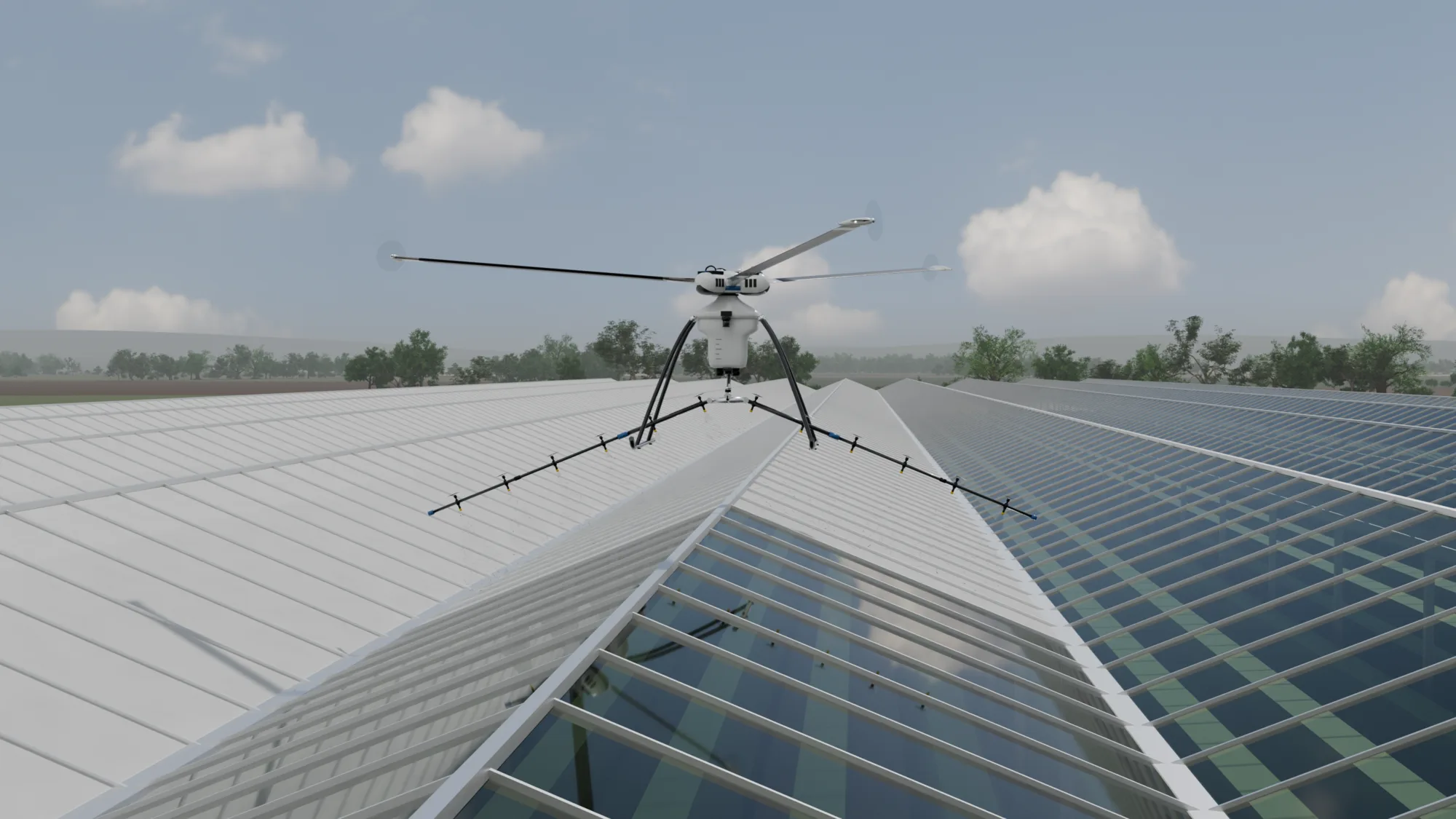
ANDURANCE heavy-lift over a greenhouse, artist's impression
ANDURANCE heavy-lift over a greenhouse, artist's impression.
ANDURANCE at a glance

The essentials in six points

What it is
A drone with one large rotor, driven by three small propellers at the blade tips (tip-propeller drive). The architecture is protected by US patent 10,864,989 B2.
What already flies
The agricultural version has carried 15 kg for 15 minutes in field seeding trials in 2022, and flies for over an hour with a light payload.
What is being built
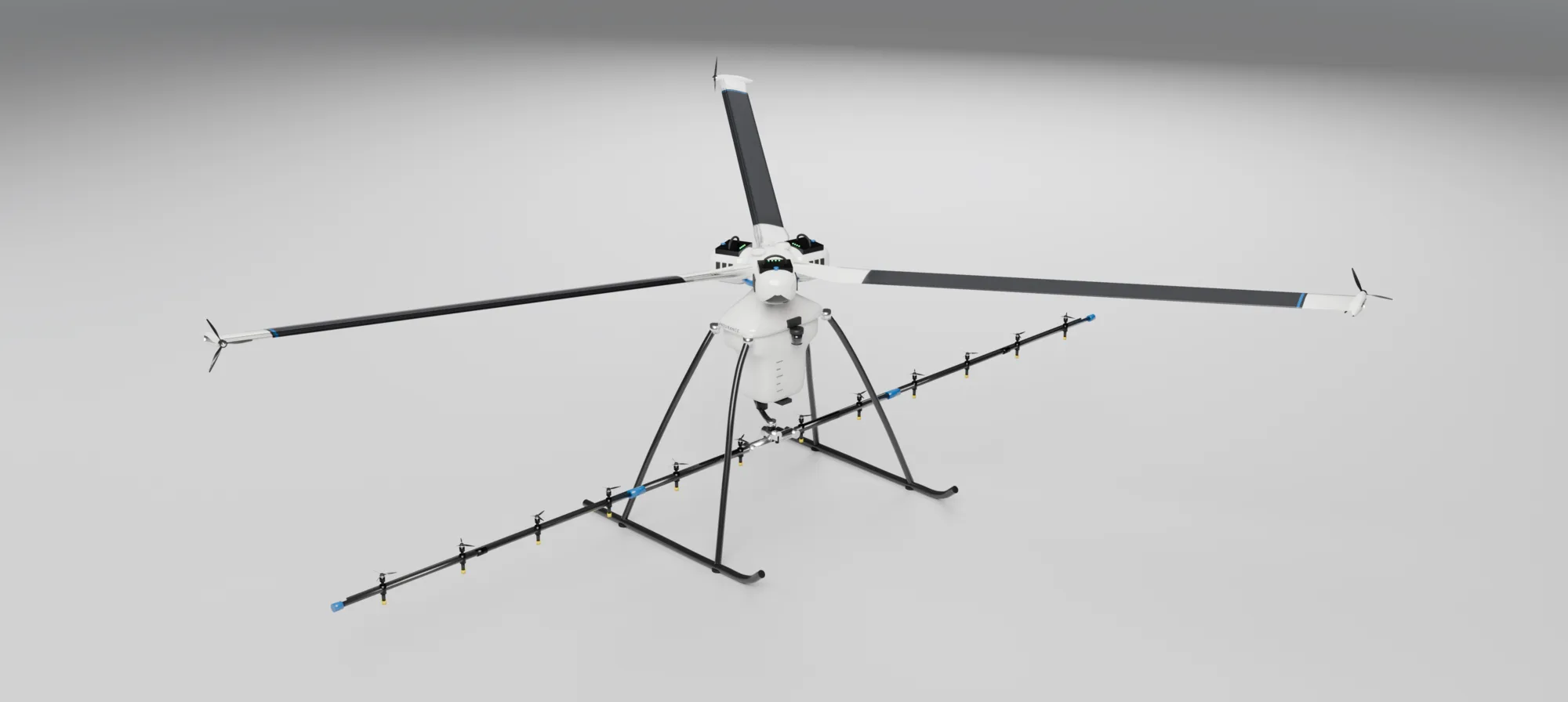
A heavy-lifter with a 50 kg payload, about 115 kg take-off weight and a 6.5 m rotor. First flights targeted for February 2027. These figures are design targets.
Which missions
Agricultural spraying with a 6 m boom and anti-drift nozzles, greenhouse whitening, seeding, logistics and resupply of isolated sites. Designed for dual use, civil and defence.
How it differs from a multirotor
About six times lower disc loading (3.5 vs 22 kg/m², calculated), so less power to lift, a gentler downwash, a machine designed to be quieter, and autorotation after a power loss.
Who designs it
Anemos Technologies, Saint-Étienne, France, flying this rotor since 2018. Talk directly to the design team.

The principle

More endurance, less downwash: the large-rotor advantage

A multirotor spreads its weight over several small discs. ANDURANCE spreads it over one large disc. Lower disc loading means less power to keep the same kilo in the air, hence more endurance, and a gentler downwash under the machine.

The rotor turns slowly; the tip propellers do the fast work. There is no reaction torque to counter, and after a power failure a spinning rotor comes down in autorotation.

The architecture is protected by US patent 10,864,989 B2.

For a 115 kg take-off weight, at full load

Disc loading, ANDURANCE3.5 kg/m²
Large agricultural multirotor22 kg/m²
Downwash under ANDURANCE7.5 m/s
Downwash under a large multirotor19 m/s

Momentum theory, from published dimensions: a 175 kg multirotor on four 1.57 m discs.

ANDURANCE propulsion

Propellers at the blade tips: what it changes for you

On a helicopter, a central engine turns the rotor through a gearbox, and a tail rotor counters the torque. On a multirotor, four to eight small propellers blow hard to carry the load. ANDURANCE works differently: three small propellers at the blade tips drive a single large rotor. The rotor is pushed from its tips, not driven from its centre.

Top-view principle diagram: three propellers at the blade tips turn a single 6.5 m rotor.Blade-tip propeller← Thrust3 m bladeRotor Ø 6.5 mThe rotor turns slowly
Principle diagram, top view.

More endurance

A large disc moves a lot of air slowly: to carry the same weight it needs less power than several small discs. And because the motor sits at the blade tip, the blade carries no drive torque: the 6.5 m rotor stays light. The energy on board lasts longer.

Less noise

The large rotor turns slowly and only three small propellers work fast, where a multirotor drives four to eight heavily loaded propellers. ANDURANCE is designed for a quieter acoustic signature, an asset for defence missions as well as for farms' neighbours. We will publish measurements after flight testing.

A gentle downwash

The air comes down about two and a half times slower than under a large multirotor of the same mass (calculation above). For spraying or whitening, a moderate downwash helps put the product where it belongs.

No gearbox, no tail rotor

The tip propellers drive the rotor directly: the hub passes no torque to the fuselage. No tail rotor, no gearbox to service, fewer mechanical parts that wear.

Two safety nets in case of failure

If one blade-tip propeller stops, the other two keep driving the rotor: ANDURANCE is designed to continue flying in degraded mode and reach its landing area. If all power is lost, the spinning rotor comes down in autorotation and slows the descent, like a helicopter's.

One technology, several machines

The same principle flies our agricultural drone, which has already carried 15 kg, the 50 kg heavy-lifter under construction, and the large propeller of the ANDIR airship.

Three ways to lift a load

ANDURANCEMultirotorHelicopter
Lifting rotors1 large rotor4 to 8 small rotors1 large rotor
What turns the rotor3 blade-tip propellersone motor per propellera central engine and a gearbox
Tail rotornonoyes, or two counter-rotating rotors
Downwash under the machinemoderatestrongmoderate
Noisereduced, to be measured in flighthighhigh
One motor failsdegraded flight on the other 2 propellersquadcopter: falls; 6 to 8 rotors: degraded flight possiblesingle engine: autorotation
Total loss of powerautorotationfallsautorotation
Mechanics to maintainreducedsimpleheavy

Comparison of principles, at equal mass. ANDURANCE heavy-lift performance will be measured in flight.

Flying

Already flying: 15 kg for 15 minutes

Our ANDURANCE prototypes have been flying for several seasons. The agricultural version, shown here in field trials, has carried 15 kg for 15 minutes, and flies for over an hour with a light payload: the principle is proven in flight, not just on paper.

Seeding trials in the field at Chenereilles (Loire, France), August 2022. One-minute video; click to play.
In development

The heavy-lifter: 50 kg to spray or resupply

We are building a 50 kg payload version. For agricultural spraying, it carries a 6 m boom fitted with anti-drift nozzles from the official French list, each half following the slope of the ground. It is designed for the rules in force in France since June 2026, which recognise only this category of equipment to limit drift when spraying by drone. It is also aimed at greenhouse whitening, where a gentle downwash helps lay down an even coat.

The same carrier serves logistics: resupply where vehicles cannot go, for civil and defence needs. ANDURANCE is designed for dual use.

The figures below are design targets. Flight figures will be published once testing has measured them.

ANDURANCE heavy-lift, 3D render
Payload
50 kgtarget
Take-off weight
≈ 115 kgtarget
Rotor
Ø 6.5 m3 blades of 3 m
Spraying
6 manti-drift nozzles
Use
Dualcivil and defence

Design targets, not yet measured in flight.

Timeline

Where the heavy-lifter stands

Future dates are targets; we will update them as testing progresses.

  1. September 2026

    Design started

    Sizing, 3 m blades, avionics, supported by the European ECDI programme.

    Done
  2. October 2026

    Flight-test application filed

    Application for test-flight authorisation filed with the French civil aviation authority (DSAC) on 27 October.

    Done
  3. February 2027

    First flights

    First test flights of the prototype, over a clear field.

    Target
  4. March 2027

    Spraying demonstration

    Spraying water with the 6 m boom, for a first demonstration.

    Target
  5. Next

    Field measurements

    Deposition and drift measured in real conditions, with partner farms.

    Target

Join the trials

Farms, cooperatives, technical institutes: we are looking for fields and partners to measure deposition and drift in real conditions. You see the results first, and discuss them with the people who designed the machine.

Logistics and dual use

Delivering where vehicles cannot go

Resupply

Carry equipment, spare parts or supplies to an isolated site, in the mountains or after a disaster, with no road or track.

Cradle or sling load

Two ways of carrying are under study: the load fixed under the drone, or hung on a sling to set it down without landing.

Civil and defence

ANDURANCE is designed for dual use: the same qualities, endurance, low acoustic signature, moderate downwash and autorotation, serve civil and defence needs alike.

Airship

ANDIR: keeping watch over a site

For persistent observation, site surveillance or telecom relay, an airship stays aloft for a long time, provided it has a large propeller. For 10 kgf of thrust, a 30 cm propeller needs about 2.3 kW; a 2 m propeller, about 350 W (ideal theoretical values). That large propeller still has to stay light: this is what ANDURANCE technology makes possible.

Our 4 m demonstrator carries 1 kg for 30 minutes. Next target: 5 kg for 3 hours. A solar variant is under study.

Have an airship? We can study with you how to fit the ANDURANCE rotor to it. The ANDIR airship itself is not for sale today.

Our technical video (56 s): a 2 m propeller gives the same thrust with a slipstream seven times slower. Click to play.
Why us

Over ten years flying this rotor

ANDURANCE was not born on a spreadsheet. Each version flew, broke, and taught something to the next.

  1. 2015

    First prototypes; Anemos founded in Saint-Étienne.

  2. 2017

    Full-size two-blade mock-up.

  3. 2018

    First flight tests of the tip-driven rotor.

  4. 2021

    Three-blade version flying.

  5. 2022

    Agricultural version: 15 kg for 15 minutes, seeding in the field.

  6. 2026

    50 kg heavy-lifter under construction.

Architecture protected by US patent 10,864,989 B2. Designed and built in Saint-Étienne, France. We also design custom drones, such as a multi-sensor drone for Thales.

Questions

What people ask us about ANDURANCE

Why put the propellers at the blade tips?

Because that is where their effort turns the rotor most, and there is then no torque to counter: no tail rotor, no gearbox. The rotor can be large and light, hence energy-efficient.

Is ANDURANCE quiet?

It is a design goal: one large, slow rotor and only three small fast propellers, instead of four to eight heavily loaded propellers on a multirotor. A low acoustic signature matters for defence missions as well as for neighbours. We will publish measured noise levels after flight testing.

Is the 50 kg heavy-lifter for sale?

Not yet. First test flights are targeted for February 2027 and a spraying demonstration for March 2027. We are looking for farms and partners for field trials.

What happens if a motor fails?

If one of the three blade-tip propellers stops, the other two keep driving the rotor: ANDURANCE is designed to continue flying in degraded mode and reach its landing area. And if all power is lost, the large spinning rotor comes down in autorotation, as on a helicopter.

Can ANDURANCE be used for greenhouse whitening?

It is one of the intended uses: a gentle downwash and a 6 m boom help lay down an even coat. We will offer it once the heavy-lifter is on the market.

Where is ANDURANCE designed and built?

In Saint-Étienne, France. The architecture is protected by US patent 10,864,989 B2, and the heavy-lifter's development is co-funded by the European Union under the ECDI programme.

Can ANDURANCE propulsion be used on another aircraft?

It is possible: we can study with you how to fit the ANDURANCE rotor to your airship or aircraft, and we design custom drones.

Co-funded by the European Union ECDI, European Cluster for Drone Innovation

This project is co-funded by the European Union's Single Market Programme under grant agreement No.101236201.

The development of ANDURANCE heavy-lift is supported by the European ECDI programme (Civil Drones Innovative Programme), coordinated in France by Aerospace Valley. The views expressed are those of the author only; neither the European Commission nor the ECDI project is responsible for any use that may be made of the information on this page.

Contact

Tell us about your mission

Spraying, greenhouse whitening, seeding, cargo, observation: tell us about the mission, the payload and the terrain.